
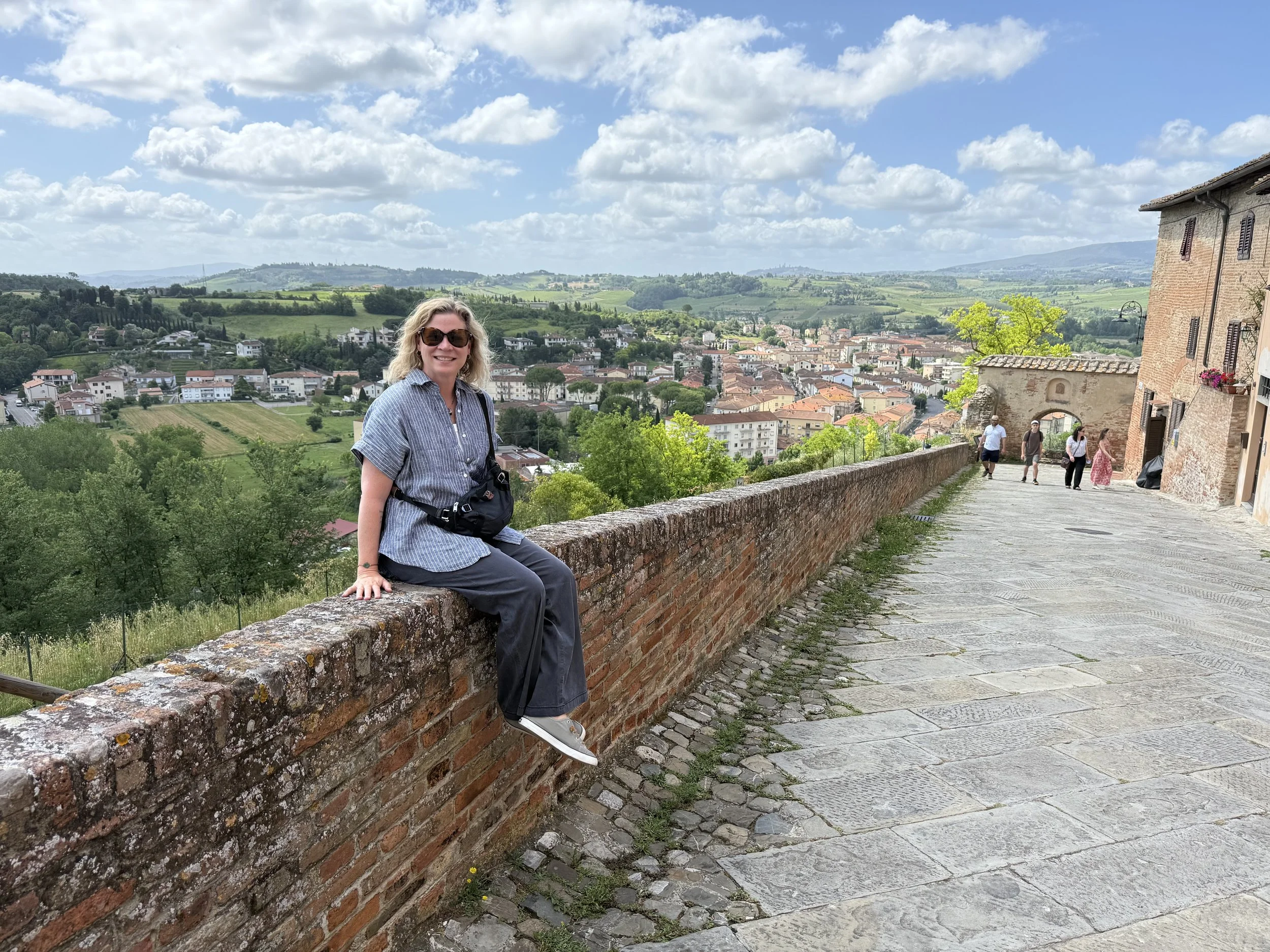
Are We A Fit?
In my world kindred spirits are born from personality, not pathology, and sharing a diagnosis doesn’t mean we are instantly bonded. While I can help many people in the breast cancer community, some of you are going to find yourselves here and know you belong.
You were someone before cancer decided to take over your life.
You're probably a traveler. Or a mountain biker. Maybe a hiker who reads the trail map before anyone else is awake. A weight lifter, a motorcycle rider, a Zumba instructor, a skier, a gardener, a yogi, a baker, a writer, a potter, a poet, a painter. A mom who gets down on the ground to play, or a grandmother who chases her grandkids at the park. A retired nurse, a quilter, a church-circle regular, a woman who walks her neighborhood every morning and knows every dog by name. A volunteer who shows up for everybody else first. A woman with a full-time job and a full life.
You were healthy. Busy. Active. You were fun. You didn't see cancer coming, because nothing in your life suggested it.
And cancer hasn’t become your identity. You probably don't post about it much. You're likely not a fan of traditional support groups, online or in-person. Most of the people you see in a week couldn't tell you what your exact diagnosis was or what type of surgery you had. You focus on your real life and keep the hard parts to yourself, because there is never a good place to put them down. This is the “you” you are trying to be, but cancer keeps demanding your attention. You are what I call the “silent majority in breast cancer land.”
I know, because I've met you before. Every person I’ve described is someone I’ve already worked with.
And this is what makes it extra hard for you.
You're capable. You've always been the one who runs the show: the one people call when something breaks, the one who figures it out, the one who takes care of things and everyone else. You've handled harder projects than this one. But now your body is the project and it came with no instruction manual.
You were sent home with appointments on a calendar and the expectation that you'd figure out the rest. So now you're left in charge of your own recovery without the knowledge or the skills for it, and for the first time in your life, competence alone isn't enough. You can do everything “right” and still not know what your own body needs.
It's a body you don't recognize, and maybe don't want to look at. Joints that ache and slow you down. Fatigue that keeps you from showing up like you’re used to. And nobody told you the rules — or worse, everyone told you different ones. One handout says fifteen pounds, one practitioner says no blood pressure on that side, one Facebook group tells you everything that could go wrong. So you're left doing your own risk math on every grocery bag and grandkid, deciding what you're 'allowed' to do with no one to check your work.
Because here’s what cancer actually takes.
The ability to take your body for granted.
Maybe you didn't trust it so much as you never had to think about it - and that was fine. That’s the arrangement most of us have with our bodies until something goes really wrong.
The confidence to do what you love without doing the math first.
You used to hit the gym 4-5 times a week but now you don’t know whether to limit your weights or your reps. You approach lifting your grandchild or walking your dog like a calculated risk. You don’t feel safe hitting the slopes anymore, let alone the black diamonds you used to love, thinking about the damage you could do to your reconstruction, your surgery sites, the swelling you're terrified of inviting back.
The certainty of knowing what's normal for your own body.
You've typed 'is it lymphedema or…' into a search bar and closed the tab two minutes later, because every answer contradicted the last one and there was no way to know who to trust.
You know you're more than a body. But here's what nobody tells you: the way back to yourself runs through it, not around it. Cancer cut the connection. Rebuilding it is the work.
And here’s how you’ve been coping, so far.
You're outrunning it. Type A, driven, keeping pace with your old life or even a faster one — partly because staying busy means you don't have to feel what happened. Except your stamina isn't what it was, and some part of you knows you can't outrun it forever.
You're avoiding it. Facing it feels like too much, and you have no idea where you'd start. So you pretend like you’re past it.
Your grief and anger are always just below the surface. You can’t talk about it without tears welling up as you try to hold them back because you’re afraid if you start you won’t be able to stop.
Your relationship with your body was already hard. You judged it and worked on it and tried to fix it long before any of this. Cancer made the distance wider and you don’t know how to bridge the gap.
You're doing okay - mostly. Your life is good, your people show up, and you don't need rescuing. But every now and then you look at your body and think, "what the actual f*ck is going on here?" - and there's no one to ask. That counts too. You don't need to be in crisis to want to make sense of your body.
And somehow, through all of it, you still come last on your own list. By nature or by circumstance, everyone else gets taken care of first.
And none of this depends on where you are in your experience. Newly diagnosed and still in treatment. Just finished and wondering what now. Nine years out like me, or living with metastatic disease and navigating a different map entirely. The experience changes shape — the woman inside it doesn't.
But here’s what you really want.
You want to live a long time. Sure. But that's not the real want.
The real want is to enjoy your days. To be at the wedding, present and having fun, not managing pain through it. To take the trip — the one you booked in the chemo chair as a promise to yourself. To ride the bike. To eat and drink what you love. To look in the mirror and see yourself instead of a reminder of cancer. To be intimate — with a partner, or just with your own life again. To work. To travel. To live, laugh, love, and all that jazz.
It all comes down to one word: freedom.
The freedom to do what you love without fear. To live in your body without pain or confusion calling the shots. That's what you're after. That's what I'm all about and what I’m here to help you find.
And what you call it matters.
And while we're on the subject of freedom - it includes your words too. Because cancer hands you a vocabulary you never asked for, and around here you get to sort through it and keep only what fits.
If "survivor" fits you, use it freely: it's your experience to name. If it doesn't, you're in the right place anyway. I do use it myself because it’s the word most people understand. But it carries a win-or-lose framing I never signed up for, and I have no use for battle language around cancer. You won't find me using terms like pink sisterhood, "breasties," or breast friends here either — nothing that makes this experience cuter than it is (because there’s nothing cute about it).
Around here you're a woman who had breast cancer, someone who lives with a breast cancer experience, or whatever name you've decided fits — it's yours to pick, and while I respect all self-assigned labels, I don't stick them on others.
Here's what else I stand for. Does it sound like you?
You don't have to be loud about your experience to belong here.
You believe healthcare is a right, not a privilege - and that human rights matter more than profits.
You’re with me that reproductive rights and bodily autonomy are about so much more than abortion and that they are central to improving women’s healthcare.
Trans rights are human rights. You're an LGBTQIA+ ally, and you know that who someone loves or how they identify harms no one - and that the real harm is done to the people bullied or oppressed just for trying to be themselves.
You're anti-racist, pro-immigrant, and you believe black and brown women deserved better from the medical system centuries ago, and sadly still do.
You'd rather your tax dollars plant trees and feed kids in your community than start wars we can’t end.
You vote. Not because it’s a perfect system, but because you understand what it is: a right, a privilege, and a responsibility. You'd rather see someone vote than not vote, even when you'd never vote the same way.
You'd rather see people lose their guns than see one more child die in another school shooting - because your vote is about your community, not just yourself.
You try to live by values like these: love, freedom, curiosity, joy, sustainability. Not perfectly — but they're the measure you keep coming back to.
You believe and trust women. And fuck the patriarchy. Obviously.
The color pink is complicated for you. You’re not trying to hide your experience but you don’t want to wear it on your back like some sort of branding or social club, either.
You've also intentionally stopped buying from the brands that slap a ribbon on everything in October (and maybe even called out a few who have but aren’t showing receipts for how they “help”).
You know awareness isn't the finish line, especially for metastatic breast cancer, where research funding still doesn't match the critically high stakes.
You know that a cancer experience is about so much more than treating the disease and that the system didn’t set you up for success in survivorship (I go deep on this on my philosophy page).
If some of this makes you want to click away, it’s ok because maybe I’m not the right guide for you, and I mean that without hard feelings. You don't have to check every box - but if most of it made you exhale, I invite you to keep reading.
On investing in yourself...
You already know the free version of cancer support. Support groups. Pink rubber bracelets. A hodgepodge of tote bags and makeup samples and whatever the nonprofits scrounge up. Some of it is lovely. None of it goes deep or gets to the heart of what you live with every day.
That’s why you don't believe everything in cancer land should be free — because you know what free gets you, and you know what your healing is worth. Starting with free resources is fine. But going deeper means investing your time, your energy, and yes, your money in the things that matter to you — and your healing is at the top of that list, even if until now, you've spent years putting yourself last on it.
On spirituality...
You have an open heart about it, whatever it looks like for you. Faith, religion, practice, or none of the above — you let people believe what's true for them without judgment or expectation. For the record: I don’t align with any particular faith or religion, but I do believe in a universal connectedness among all beings and the magic that creates and I understand the need for a belief in something greater than ourselves. I’ve seen too much to be an atheist or nihilist and it’s also perfectly ok if you are.
On adventure...
At home or across the world, you love experiencing what a place has to offer — the culture, the music, the history, the food. You're the one who plans the trip, finds the trail, and makes sure you all make it back safely at the end of the day. You're the one who finds the tiny restaurant two streets off the main square, who books the tour nine months out, who has a list going for the next place. Maybe you booked a trip during treatment just to have something to live toward (I know I did!). And sometimes your favorite adventure is the one that involves a few friends and a quiet night in. And I love that about you.
On health and food...
You know that food is about nourishment, not punishment or reward. Enjoyment doesn't have to mean overindulgence, but it definitely doesn't mean using food as a form of control, or letting fear deny you another cookie or night out because some headline said it causes what you've already survived.
And it was never just food. It's the same reflex in the bathroom and under the sink — the deodorant thrown out after a scare post, the "clean" moisturizer that cost more than dinner and didn’t take away your wrinkles, the cabinet full of products you bought out of fear instead of what actually works for you. Somewhere along the way "healthy" got confused with "anxious," and you're done letting a headline decide what goes in you or on you.
Health, to you, means balance with what actually works for your life: homemade deodorant or Dove off the drugstore shelf. Organic when you can, frozen when you need to. The workout and the nap. The green smoothie and the wedding cake. What works, what you enjoy, what you'll actually keep doing — that's the whole standard.
You often find yourself talking about...
Nature. Creativity. Whimsy. Feminism. Love. Personal growth. Learning new things. The book you're reading, the trail you found, the hobby you’ve started, the business you're building, the grandkid who said the funniest thing. Whatever it is, it lights you up, and you light up other people with it, even when you're quietly running on empty yourself.
And a last bit about me, since you've read this far.
I'm a cis-(mostly)het 50 year old white woman, diagnosed at 41, currently with no evidence of disease. I’ve been working in this field since 2012 and first learned about breast cancer at age six with my grandma’s diagnosis. I do my best to be inclusive of every lived experience, and I'll be honest with you: some of them I can't know, because I haven't lived them. What I can do is keep learning, keep listening, and be a useful resource anyway. If your experience is different from mine, you still belong here — I just promise to never pretend I know exactly how it feels in yours.
And because fit is about whole people, not just work: I travel the world with my husband, friends, and family. Gen-X Swiftie. Buffy superfan. Kenny Rogers devotee. Happiest in tattoos and overalls. Obsessed with opossums and shopping secondhand. Former semi-professional a capella singer, former artisan bath salts maker. I joke that I have to thank cancer and Lexapro for curing my fear of flying — I've since gone paragliding in the Swiss & Italian Alps.
The full story of how this previvor became a practitioner became a survivor lives on my bio page.
We probably are NOT a fit if...
You want quick tips without the context like a 30-second demo or a top 5 list of triggers to avoid. Those exist everywhere. Real healing takes more, and that's the only kind of work I do.
You want someone to fix you. Our goal is self-sufficiency, self-reliance, and self-confidence. The whole point is you moving from dependent patient to the director of your care team.
You aren’t willing to get curious and try new things. No one person or program can solve all of your problems (including me), so you need to be open to trial and error and customizing your toolbox along the way.
You’re looking for a breast cancer influencer. I'll celebrate with you and I’ll commiserate with you, but I don’t dance or sing about cancer.
You find swearing unprofessional or inappropriate. I know when to walk the line but you deserve all the fucks I have to give.
Feel Like We Might Be A Fit?
Here are 3 ways to get started:
01
Start for Free
I have multiple ways to start your self-care journey with me, completely free.
02
Learn More
DIY resources to jump start your knowledge and skills at home on your own.
03
Go Deeper
Go deeper with hands-on care, 1:1 guidance, and a comprehensive self-care program.